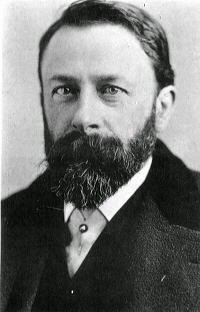
When I looked back through my posts to study for my midterm exam, I realized that I had neglected a post on Karl Bodmer and his patron Prince Maximilian. I intend to remedy that here, and give a few examples of how exacting and detailed Bodmer’s work was. If you appreciate it for no other reason, you should at least respect its authenticity.
Karl Bodmer (February 11, 1809-October 30, 1893) in 1877 A lifetime after his expedition with Prince Max
The year is 1851, you make your way through the streets of Philadelphia to a small theatre where scores of other interested parties are milling around waiting to be allowed in. You deposit your 25 cents for admission (12.5 cents for any children you have in tow) and make your way inside. The din of attendees drown out any discernible conversation as everyone finds their place before the show starts. For weeks printed advertisements have been calling this something you did not want to miss. Not only will they be displaying a full moving of the Mississippi River but it will be accompanied by the eminent Dr. Dickerson’s lectures which were “by themselves worth twice the price of admission.”
Advertisement for Dickeson’s Scientific Lectures. Source.
This weekend I had the opportunity visit the Amon Carter Museum of American Art in Ft. Worth, Texas. If you are ever in the vicinity make room for a stroll through Ft. Worth’s Cultural District over to Camp Bowie Street and visit. Carter’s bequest that set up the museum after his death has made it possible for the museum to maintain FREE admission to this world class installment of American Art.
The second part of the grandscape troupe (of which there are more than two, really) features Thomas Moran. Moran was born in England but became one of the most identifiable and popular members of the Hudson River School. He started as an engraver but found it tedious, worked in watercolor, and later produced some oils on the same scale as the ones we saw with on the Albert Bierstadt post. He shared a studio with his marine artist brother Edward and became an illustrator for the popular magazine Scribner’s Monthly.
With the millions of bytes of internet storage dedicated to the work of Albert Bierstadt, there is little I can say here about him that wouldn’t be said better elsewhere, what I will do is collect a few of his works here in order that I can easily scroll through them when I need a quick reminder of the quintessence of the Dusseldorf School.
Albert Bierstadt January 7, 1830-February 18, 1902
More can be written about the American painter Thomas Cole than I could possibly wrap up in a single post, especially with my extremely limited knowledge of him and his work, but I do know some things worth sharing and hope they may lead you elsewhere for your own private elucidation.
When the American Art Union set out to up the standards of American artwork it sought specifically scenes of everyday life in addition to the great high-minded historical painting. One artist capitalized on this trend of “everyday life” paintings in ways few others had or have.
If you are ever presented with a painting featuring some buckskin clad fur trappers in one or more familiar romantic composition, serve up a guess that it was painted by Alfred Jacob Miller and you will be correct more often than not. In fact, Miller was the only painter of his generation to paint the fur trade, so if you know that the painting in question was created in the early 19th century, you would be right 99.99% of the time.
Many pages have been written about George Catlin. The grand total falls somewhere close to an acre of paper timber (I completely made that up so don’t go putting it in your Catlin notes). That hyperbole is, in all actuality, probably a low estimate. Many more megabytes of data have been used on blogs and digital storage of some of his famous Indian paintings. If you ever get a chance you should look more in depth than here about his life, his showmanship, his critics, and his art. One day I hope to have a short post with some of his South America art too, but that is for a later time.
I was most recently tagged in one of those social media chain letters asking to produce a number of books that make my “good reads” list. I saw someone else post it the day before as the 10 (I think) books that changed your life. I think about these whenever I see them, even if I am not tagged, but being tagged with a separate set of list instructions really put me to thinking about reading, and the books that I have.
My library. Really choose only a handful? I have read completely about 75% of these. Most of the rest are for reference.