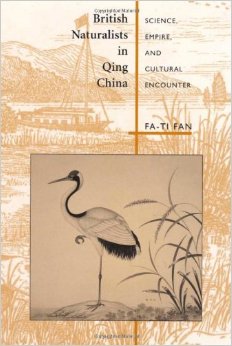
Can a book only 11 years old be a classic? If any work can claim to be such it is surely Fa-ti Fan’s British Naturalists in Qing China: Science, Empire, and Cultural Encounter. This is a huge geographic and political shift from the previous books that have dealt with India and British India. I make that point because it is important to remember that the earliest relationships with China were undertaken pretty much under Chinese terms. Even following the end of the Opium Wars and the forceful opening of trading ports China was never a colony under the British Crown.
Matthew H. Edney’s book Mapping an Empire: The Geographical Construction of British India 1765-1843 is not a book one grabs to read before bed. In fact it is almost impossible to digest in the week that we scheduled to discuss it in my directed reading meeting. It is, however, an excellent text book on the history and science of surveying and construction of empire. I mean the latter quite literally on paper (maps) and ideologically (colonial minds so to speak). That being said, it is difficult to provide a simple overview to that Edney’s work is all about. One one level, a base level if you will, it is about mapping. It is also about colonialism, empire, governance, surveying, and more precisely control.
In the modern vernacular Richard Drayton’s 2000 book Nature’s Government: Science, Imperial Britain, and the ‘Improvement’ of the World falls somewhere between a “mic drop” and ” could’ve had a v8.” That is to say that his main argument that Britain was just as influenced by its colonial holdings as its colonies were by the crown is either an astonishing bombshell of historical argument or is the most obvious thing you have ever heard. As you follow his argument from the broadest coverage of colonialism down to the minutiae within the offices of Hooker and Gladstone in Kew and Parliament (respectively).
Jim Endersby published the aptly titled Imperial Nature in 2008. The book is an absolute delight to read which is one of the reason it has taken so long to get a post up. It is a book that is so interesting that you simply cannot scan through for the high points. My penchant for word play heightens the enjoyment of the title. At first glance it may mean simply nature that belongs to the Empire, but deeper within you will find that this type of botanizing (and science methodology, actually) is part of the nature of the Empire as well.
David Elliston Allen’s 1976 social history of the naturalist in Britain is by all accounts “a classic.” Interestingly enough it was republished in 1994 by Princeton University Press from its original Penguin Books which brings into the question the relationship of popular press vs rigorous (inflated pricing) of university presses, but you can take that up on your own.
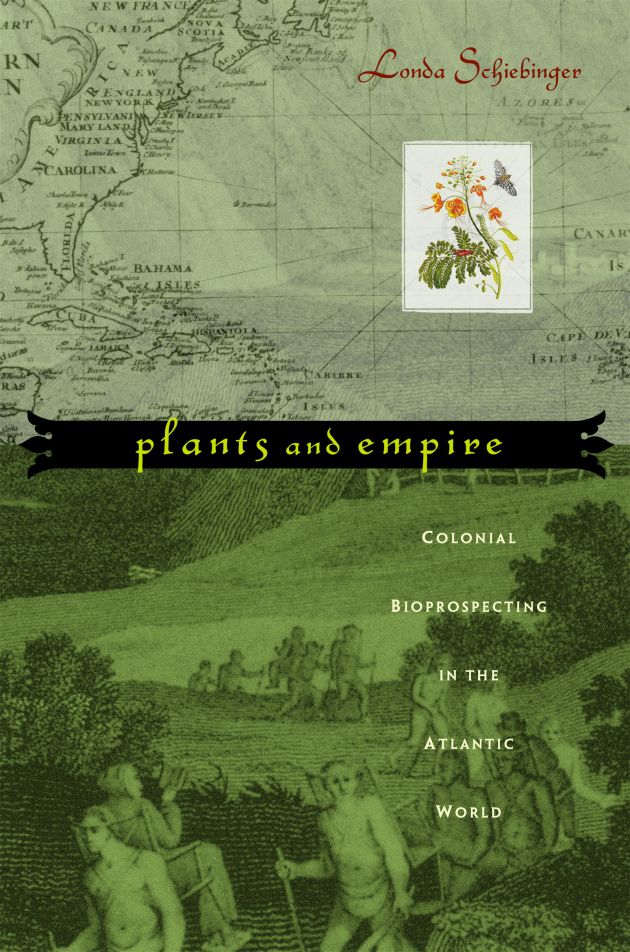
Plants and Empire (and abortion) by Londa Schiebinger
This is a book about abortion. That is to say that this work is about plants used to induce an abortion in the early modern period. Deep in the heart of the book it is also about abortions as political economy against slave-owners. Thankfully for the publisher, it is also a book about “indigenous knowledge” and the transfer of knowledge through trade routes and from colonies/territories to the imperial possessors. In fact, it is more about the nontransfer of knowledge in the case of a particular plant used as abortifacients (a word you will truly get sick of seeing in not because of its connotations, but simply for the repeated use). You wouldn’t get the sense that “abortion as resistance” is a major theme in Schiebinger’s work from the title of the subtitle. I believe this is a calculated move on the part of Harvard University Press to allow this book to appeal to more than academics, which is should because Schiebinger is a fantastic author and the book can be easily taken up by non-specialists and it should be.
The discipline of History of Science, Technology, and Medicine has began to pride itself on the inclusion of non-western narratives in their classical antiquity sector. By this I mean to say the inclusion of Arabic sources and Islamic scientists. Some of those same people still completely ignore 1/3 of the European continent when they shift to the categorical “Early Modern” period. By extension this oversight leaves out an enormous wealth of source material dealing with the western hemisphere and the landholdings of the Iberian empire (I am using this term to include Spain and Portugal as a single unit).
This past week’s study was a foray into the Jardin du Roi and how it, and many of its staff, managed to weather the French Revolution and come out as the Muséum national d’Histoire naturelle. E.C. Spary’s 2000 work is highly developed and pretty involved with the politics and poetics of natural history from Count Buffon and the Old Regime into the Republic, the Terror, and the annoying redating of things during the period that make it more difficult to follow the historical narrative. Thankfully Spary gives the regular dates in parenthesis. I will also give an early warning that there are sentences in here that have higher word counts than some of my students’ essays.
As a trudge steadily onward towards the completion of a PhD, and comprehensive exams in a few months I will be topping off my reading with some curated history of biology-esque works that will provide a bit or mortar to hold my foray into field science post Darwin to the premodern foundations and their recourse of shaking off the prefix. The first in (what I hope to be) a long line of reviews, overviews, notes, and general idiosyncratic fancies (more for myself to study for comps than anything) is Richard Holmes’ 2012 book The Age of Wonder.
I was most recently tagged in one of those social media chain letters asking to produce a number of books that make my “good reads” list. I saw someone else post it the day before as the 10 (I think) books that changed your life. I think about these whenever I see them, even if I am not tagged, but being tagged with a separate set of list instructions really put me to thinking about reading, and the books that I have.
My library. Really choose only a handful? I have read completely about 75% of these. Most of the rest are for reference.